
Most businesses don’t have a content problem. They have a process problem.
A solid content creation process is what separates teams that publish consistently, high-quality work from teams that burn out after a few sporadic bursts. Without one, even good writers end up reinventing the wheel every single time.
That’s usually where working with content creation services makes the biggest difference for growing businesses. It’s not just about getting more content out the door. It’s about building a repeatable system that doesn’t depend on any one person’s memory or motivation.
Let’s break down what an actual scalable process looks like.
Why Ad Hoc Content Falls Apart Eventually
Here’s the thing: a lot of companies start content with genuine enthusiasm. Someone has ideas, writes a few pieces, gets some early traction.
Then life happens. That person gets busy, a new priority comes up, and content publishing goes quiet for two months. It’s not a lack of ideas. It’s a lack of structure holding the whole thing together.
- Without a process, content quality depends entirely on who’s available that week.
- Ideas pile up unused because there’s no system to prioritize and schedule them.
- Consistency breaks down the moment one person gets pulled onto something else.
Honestly, this is the most common reason content efforts stall, not a lack of good ideas.
The Core Stages of a Scalable Process
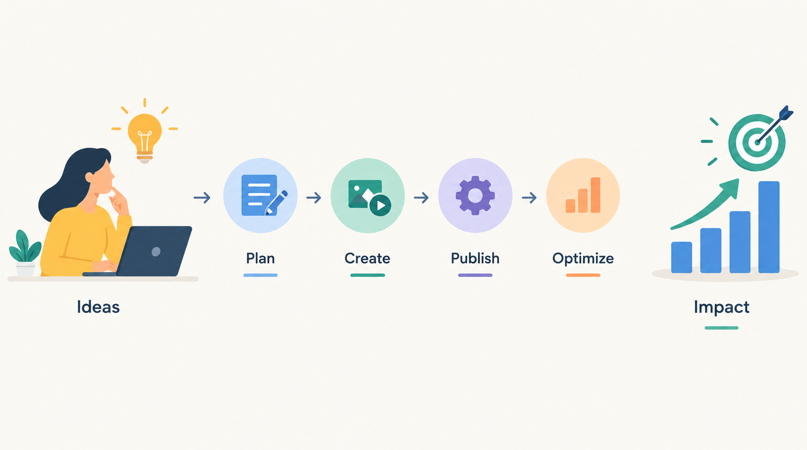
A process that actually scales usually breaks into distinct, repeatable stages, rather than one person doing everything at once.
- Idea generation: Capturing topics from customer questions, sales calls, and keyword research.
- Prioritization: Ranking ideas by business impact and search opportunity, not just interest.
- Production: Writing, editing, and formatting with a consistent quality bar.
- Distribution: Getting the content in front of the right audience, not just publishing and hoping.
- Review: Updating and improving existing content based on real performance data.
Quick summary: A scalable content process treats each stage as its own step, so quality doesn’t depend on any single person’s bandwidth.
Turning Ideas Into an Actual Pipeline
A pile of ideas in a document isn’t a pipeline. It’s just a list that gets stale.
The businesses that scale content well usually maintain a living pipeline: ideas move through stages with clear ownership at each point. Nothing sits untouched for months because nobody remembers whose job it was next.
What a Working Pipeline Needs
- A single place where ideas get captured, not scattered across emails and notes.
- Clear criteria for what makes an idea worth pursuing right now.
- Defined handoffs between research, writing, editing, and publishing.
Quality Control Can’t Be an Afterthought
To be completely fair, speed without quality control just produces more mediocre content faster. That’s not actually progress.
A scalable process builds in review steps: checking for accuracy, search optimization, and whether the piece actually answers the reader’s question. Skipping this step to move faster usually costs more time later in revisions and lost trust.
Note: A repeatable review step catches quality issues before publishing, which is far cheaper than fixing a reputation problem afterward.
Distribution Deserves as Much Planning as Writing
A lot of teams pour all their energy into writing and treat distribution as an afterthought. That’s backward.
Good content that nobody sees doesn’t help the business. A scalable process plans distribution alongside production: where does this piece get shared, who gets notified, and how does it connect to existing content on the site.
Believe it or not, this step often takes less time than writing but gets skipped more often than any other stage.
Reviewing and Updating Existing Content
Publishing new content matters, but so does maintaining what’s already live. Search rankings shift, information goes stale, and older pieces can quietly lose relevance.
A mature content creation process includes regular reviews of existing content, not just a focus on what’s new. Updating a strong-performing older piece often delivers better returns than writing something new from scratch.
Building This Without Overwhelming Your Team
Speaking of which, none of this needs to launch fully formed on day one. Most businesses build it in stages:
- Start with a simple, shared idea-capture system everyone actually uses.
- Add basic prioritization criteria before committing to a full production calendar.
- Introduce a lightweight review step before scaling publishing volume.
- Revisit and refine the process itself every few months as the team learns.
Take my word for it: a simple process followed consistently beats an elaborate one nobody actually uses.
See also: How Technology Drives Business Innovation
FAQs
1. How long does it take to build a working content creation process?
Most teams can establish a basic version within a few weeks. Refining it into something that scales smoothly typically takes a few months of consistent use and adjustment.
2. Do small businesses need a formal content process?
Yes, even a lightweight one helps. Without any structure, content efforts tend to stall once the person driving it gets busy with other priorities.
3. What’s the biggest mistake businesses make when scaling content?
Prioritizing volume over consistency and quality control. Publishing more often without a review step usually produces content that underperforms and needs frequent revision later.
4. Should distribution be planned before content is written?
Ideally, yes. Planning distribution alongside production ensures content reaches its intended audience instead of sitting unseen after publishing.
