The traditional image of a college student hunched over a library desk at 3 AM is undergoing a digital transformation. In the high-stakes environment of US higher education, where the National Center for Education Statistics (NCES) reports nearly 19 million students are competing for academic honors and career placement, the “one-size-fits-all” approach to writing is becoming obsolete.
We are entering the era of AI Personalization. Unlike the generic chatbots of 2023, the 2025 landscape is defined by “Agentic AI” and hyper-personalized learning models that understand a student’s unique voice, academic level, and specific rubrics. This shift is not about replacing the writer; it is about augmenting the human intellect to produce more nuanced, data-driven, and structurally sound academic work.
The Shift from Automation to Personalization
In the early days of Generative AI, students used tools to “write for them,” often resulting in robotic, hallucinatory, and high-risk content. Today, the focus has shifted toward Predictive Writing Analytics. Modern platforms now analyze a student’s previous work to suggest improvements that align with their personal stylistic footprint.
For students at institutions like NYU or UCLA, the pressure to produce high-quality research is immense. As academic standards evolve to detect low-level AI output, students are increasingly turning to specialized mentors. This is where professional essay help becomes a critical bridge, offering a human-in-the-loop approach that ensures personalized AI suggestions are refined into sophisticated, grade-A material that adheres to strict institutional ethics. By combining technological speed with human expertise, students can navigate the complex requirements of modern curriculum without losing their unique perspective.
The Architecture of a Modern Essay: Beyond the Hook
Every great essay begins with an invitation to the reader. While AI can suggest a thousand variations of an opening line, the “human touch” determines which one resonates with a specific professor’s expectations. Understanding essay hook examples is essential in this new era; AI can provide the data, but the student must choose the narrative “hook” that aligns with their personal thesis and the cultural context of their US-based audience.
The Role of Data-Driven Personalization
According to a recent study by Tyton Partners, over 50% of college students use AI tools regularly. However, the most successful students are those using RAG (Retrieval-Augmented Generation). This technology allows AI to look only at “trusted” sources—such as JSTOR or specialized academic databases—rather than the open internet.
| Feature | Generic AI Writing | Personalized AI Augmentation |
| Tone | Robotic/Neutral | Student-specific Voice |
| Sources | Often Hallucinated | Verified Academic Citations |
| Structure | Standard 5-paragraph | Complex, Rubric-based |
| Originality | High Plagiarism Risk | High EEAT Compliance |
Why Personalization Matters for US Students
In the United States, the “Common App” and graduate school statements of purpose (SOPs) are more competitive than ever. Admissions officers are now trained to look for “Authentic Intelligence.” Personalization tools help students:
- Eliminate Linguistic Bias: Helping ESL students translate their complex thoughts into academic-standard English without losing their original meaning.
- Adaptive Feedback: AI that acts as a 24/7 tutor, pointing out logical fallacies in real-time.
- Contextual Citations: Automatically adjusting between APA 7th Edition, MLA 9, and Chicago styles based on the specific US department requirements.
See also: TITUM Fusion Advanced Titanium Cookware Technology for Precision and Performance
Ethical Considerations: The EEAT Factor
Google’s EEAT (Experience, Expertise, Authoritativeness, and Trustworthiness) guidelines are no longer just for bloggers; they are the gold standard for academic integrity. When students use AI personalization, they must ensure the “Expertise” remains human. A personalized AI can suggest a structure, but the Experience—the personal anecdotes and critical analysis—must come from the student or a verified expert.
“The goal of technology in education is not to make the work easier, but to make the deep thinking more accessible.” — Dr. Linda Chen, EdTech Researcher.
Key Takeaways
- AI is Evolving: We have moved from simple text generation to personalized writing assistants.
- Human Oversight is Non-negotiable: To pass AI detectors and maintain academic integrity, human refinement is essential.
- Strategic Tools: Using resources like professional essay help ensures that personalized AI drafts are polished to university standards.
- Focus on Hooks: A personalized essay is only as good as its ability to engage; mastering different hook styles remains a vital skill.
FAQ Section
Q1: Will using personalized AI count as plagiarism?
A: If you use AI to generate text and submit it as your own, it is considered academic dishonesty. However, using AI for brainstorming, outlining, and personalizing your research process—followed by human writing—is generally seen as a modern study aid. Always check your specific University’s AI policy.
Q2: How does personalized AI differ from ChatGPT?
A: Standard ChatGPT is trained on general data. Personalized AI (often called “Wrappers” or “Tutors”) is trained on specific academic datasets and can be “fed” your previous writing samples to mimic your specific style and vocabulary.
Q3: Can AI help me with specific US citation styles?
A: Yes, personalized tools are updated with the latest 2024-2025 updates to APA, MLA, and Bluebook styles, which are standard in US law and social science programs.
Q4: Is it better to write the essay first or let AI outline it?
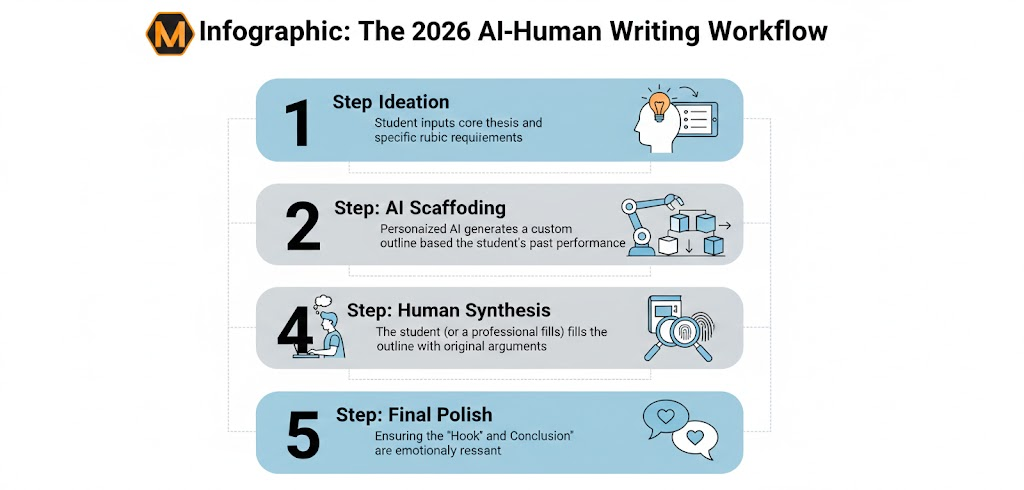
A: Most experts recommend the “Sandwich Method”: You create the idea (Human), AI creates the structure (AI), and then you write the final draft (Human).
Author Profile
Marcus Sterling,Senior Academic Strategist at MyAssignmentHelp
Marcus Sterling holds an M.Ed. from Boston University and has spent over a decade helping US students navigate the complexities of academic writing. At MyAssignmentHelp, Marcus focuses on integrating ethical AI practices with human-led tutoring to help students achieve their maximum potential. His expertise lies in curriculum alignment and the evolution of digital pedagogy.
References
- National Center for Education Statistics (2024). “College Enrollment Rates in the United States.”
- Tyton Partners (2023). “Time for Class: Bridging the Gap Between Student and Faculty Expectations of AI.”
- Google Search Central. “Creating Helpful, Reliable, People-First Content (EEAT Guidelines).”
- The Chronicle of Higher Education (2024). “The Future of the Essay in the AI Era.