
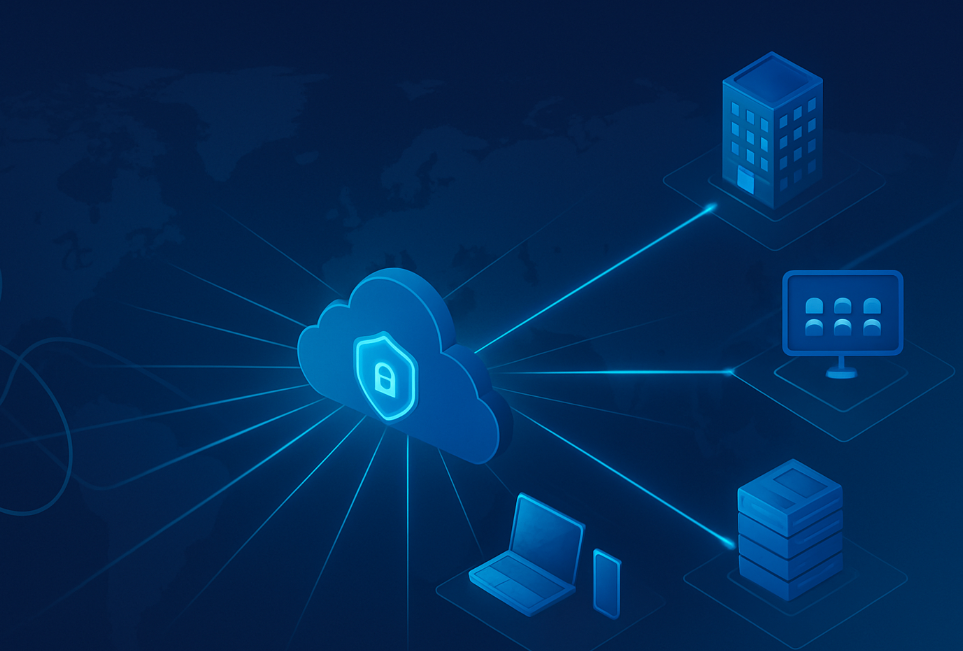
Enterprise IT teams today manage environments that would be largely unrecognizable to their counterparts from a decade ago. Applications that once lived in the data center now run across multiple cloud providers. Users who once sat behind a corporate firewall now connect from home, branch offices, and mobile devices across a range of networks that IT does not control. The tools and frameworks that worked well for securing the old model often create friction, complexity, and security gaps when applied to this new reality.
Secure Access Service Edge, or SASE, emerged specifically to address this gap. For IT professionals responsible for designing, implementing, or managing network security infrastructure, a working understanding of what SASE is, how its components function, and where it fits into an organization’s architecture is increasingly important. This guide approaches that question practically, covering what IT teams need to know to evaluate and work with SASE frameworks.
Why the Old Model No Longer Scales
To understand why SASE matters, it helps to understand the specific problems it was designed to solve. Traditional enterprise network security was built around centralized inspection. Traffic from remote users and branch offices was backhauled through a central data center, where security appliances could inspect it before allowing it to reach its destination. This worked reasonably well when most applications lived in that same data center and most users connected from fixed office locations.
The shift to cloud-hosted applications and distributed workforces broke this model in two ways. First, backhauling traffic to a central point adds latency that degrades performance for cloud applications, which need direct paths to their hosting environments rather than a roundtrip through corporate infrastructure. Second, the volume of remote connections scaled beyond what VPN infrastructure could comfortably handle, particularly as organizations moved to support fully remote workforces.
The result was a pattern familiar to many IT teams: performance complaints from remote users, overloaded VPN gateways, and inconsistent security enforcement between users on the corporate network and those connecting remotely. Adding capacity to existing infrastructure provided temporary relief but did not address the underlying architectural mismatch.
IT professionals assessing the landscape of available approaches will find that understanding what is SASE for remote access requires starting with this context because the framework’s design decisions are direct responses to these specific problems rather than general-purpose improvements to existing architectures.
See also: How Home Security Systems Protect Irish Homes Year-Round
The Architecture: What SASE Actually Delivers
SASE converges two capabilities that have historically been managed and procured separately: wide-area networking and network security. In a traditional architecture, these functions are provided by separate appliances managed by separate teams, often using separate policy systems that must be kept synchronized. SASE delivers both through a cloud-native platform that enforces consistent policy regardless of where users or applications are located.
The networking layer is typically built on software-defined wide-area networking technology. SD-WAN allows organizations to route traffic across multiple connection types, selecting paths dynamically based on application requirements, link quality, and policy. For IT teams that have managed traditional WAN infrastructure, SD-WAN represents a significant change in how connectivity is provisioned and operated: centrally managed, software-configured, and capable of adapting to changing conditions without manual intervention at each site.
NIST Special Publication 800-215, the guide to secure enterprise network architecture, examines the security limitations of current network access approaches including VPNs and traditional appliances, and evaluates how frameworks such as zero trust network access and SASE address the enterprise network landscape that has emerged from cloud adoption and distributed workforces. For IT professionals evaluating SASE architectures, this publication provides a standards-based reference for the security properties that modern enterprise network frameworks should deliver.
The security layer within SASE integrates several distinct functions. Zero trust network access replaces the implicit trust that VPNs grant to connected users with continuous, context-aware verification. Rather than placing a user inside the network perimeter after authentication, ZTNA grants access only to the specific applications the user needs, re-evaluating trust continuously based on identity, device health, and behavioral signals.
Cloud access security broker capabilities provide visibility and control over interactions with cloud applications, including sanctioned applications that IT has approved and unsanctioned applications that users may adopt independently. Without CASB controls, organizations often have limited insight into what data is flowing to which cloud services and no mechanism to enforce data handling policies across those interactions.
Secure web gateway functionality inspects outbound internet traffic, filtering access to malicious or policy-violating destinations and decrypting and inspecting encrypted traffic for threats. Firewall as a service delivers network firewall controls from the cloud, extending enforcement to locations and users that cannot be practically served by physical appliances.
Planning a SASE Implementation: Practical Considerations for IT Teams
For IT professionals moving from evaluation to implementation, SASE deployments present several practical considerations that are worth understanding before committing to an approach.
The first is the question of single-vendor versus multi-vendor architecture. Some organizations prefer to source all SASE components from a single provider, trading some degree of best-of-breed capability for simplified management, integrated policy systems, and a single support relationship. Others prefer to assemble SASE capabilities from multiple specialized providers, accepting greater integration complexity in exchange for more targeted functionality in specific areas. The right approach depends on the organization’s existing investments, the capabilities of available platforms, and the operational capacity of the IT security team.
The second consideration is migration sequencing. Organizations rarely move to SASE all at once. A common starting point is deploying zero trust network access alongside or as a replacement for existing VPN infrastructure, particularly for remote user access. This delivers immediate security improvements and user experience gains while the broader SASE architecture is planned. Branch office connectivity, cloud security, and web filtering capabilities are typically integrated over subsequent phases.
The third consideration is policy governance. SASE platforms allow security policies to be defined centrally and applied consistently across all users and locations, but this requires that policies actually be defined consistently. Organizations that have historically maintained separate policy systems for different security tools often find that SASE implementation surfaces inconsistencies and gaps that must be resolved before migration can proceed. Investing in policy review and rationalization before or during deployment reduces the risk of carrying over existing inconsistencies into the new architecture.
The Shift Away From VPNs
For many IT teams, SASE represents a significant departure from the VPN-centric remote access model that has been the default for enterprise connectivity for two decades. Computer Weekly’s analysis of remote access alternatives beyond VPNs documents how organizations are changing how they manage secure remote access as cloud environments and distributed workforces have exposed the scalability and security limitations of traditional VPN infrastructure, and how SASE and zero trust network access represent the primary architectural alternatives.
For IT professionals managing the transition, the practical differences are significant. VPNs grant broad network access after authentication. ZTNA grants access to specific applications based on verified identity and device context. VPNs route all traffic through a central enforcement point. SASE applies enforcement at the point closest to the user and application. VPNs require client software and gateway infrastructure at each location. SASE delivers enforcement from the cloud without requiring on-premises appliances at every site.
These differences translate to measurable operational changes: reduced gateway infrastructure to maintain, more granular control over who can access what, improved performance for cloud application users, and consistent policy enforcement that does not vary based on whether a user is on the corporate network or connecting remotely.
Monitoring and Visibility in a SASE Environment
One operational area where IT teams often need to recalibrate their thinking when adopting SASE is security monitoring and visibility. In traditional architectures, security telemetry flows from on-premises appliances to centralized monitoring systems. In a SASE architecture, much of the enforcement and inspection happens in the cloud provider’s infrastructure.
Modern SASE platforms generate comprehensive logs and telemetry that can be forwarded to security information and event management systems, but IT teams need to verify that the telemetry provided by the chosen platform covers the visibility requirements of their monitoring and incident response workflows. Organizations with mature security operations capabilities should evaluate SASE platforms partly on the depth and accessibility of the security telemetry they produce, not only on the security controls they enforce.
Frequently Asked Questions
How does SASE differ from traditional enterprise network security architectures?
Traditional enterprise network security relies on centralized enforcement points, typically data center appliances, through which all traffic is inspected and policy is applied. This creates latency for remote users and cloud application traffic, and creates inconsistent enforcement between users on the corporate network and those connecting remotely. SASE moves enforcement to a cloud-delivered platform that applies consistent policy at the point closest to the user and application, eliminating backhauling traffic and providing the same security posture regardless of where users connect from.
What is the relationship between SASE and zero trust?
Zero trust is a security principle that requires continuous verification of every user, device, and workload before granting access to resources, rather than granting implicit trust based on network location. SASE is an architectural framework that delivers cloud-based networking and security services. Zero trust network access is a core component of SASE, providing the access control model that SASE platforms implement. The two are complementary: SASE provides the delivery mechanism and additional security capabilities, while zero trust principles govern how access decisions are made within that framework.
How should IT teams approach migrating from VPN to SASE?
Most organizations approach VPN to SASE migration in phases rather than all at once. A common starting point is deploying zero trust network access for remote users, which delivers immediate security and performance improvements without requiring a complete infrastructure overhaul. Branch office connectivity, cloud security controls, and web filtering capabilities are typically added in subsequent phases. Before beginning migration, IT teams should review and rationalize existing access policies, as SASE implementation often surfaces inconsistencies between policies maintained across separate legacy tools.
