
Your customers get hundreds of marketing messages every day. Most of them get ignored, deleted, or forgotten within seconds. The ones that stick tend to have something in common: they feel like a conversation, not a broadcast.
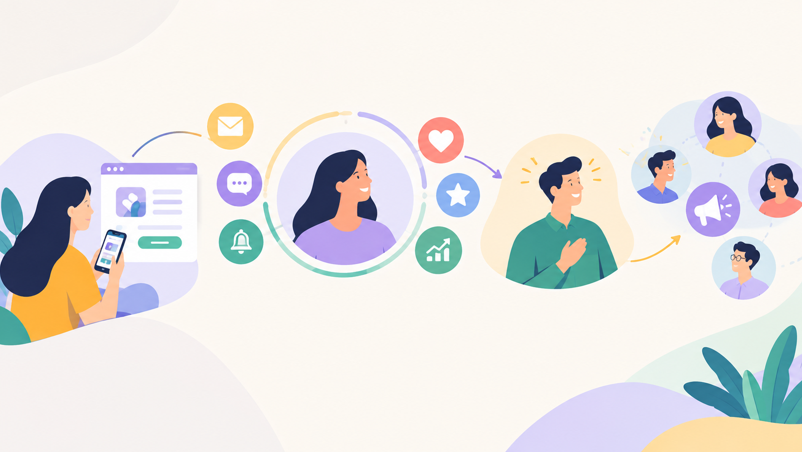
Customer engagement marketing is the shift from pushing offers at people to building ongoing, two-way relationships with them. For SaaS and subscription businesses in particular, this matters because winning a customer is just the beginning. The real growth happens after the sale, when you turn users into loyal customers who stay, expand, and eventually bring others in.
The challenge is that most teams treat engagement as a surface-level tactic. A slightly more personalised email. A one-off discount. A quarterly NPS survey. That’s not a customer engagement strategy. That’s noise dressed up as effort.
What Is Customer Engagement Marketing?
Customer engagement marketing is an approach built on meaningful, ongoing interactions between your brand and your customers across every touchpoint. It invites customers to participate in conversations and relationships that continue long after the initial purchase.
The difference from traditional marketing is fundamental. Traditional marketing talks at people and measures impressions. Engagement marketing talks with people and measures relationship depth, repeat interactions, and retention.
For teams using customer insights and analytics to track how users interact with their product, engagement marketing becomes data-informed rather than guesswork. You can see which touchpoints drive deeper adoption, which messages resonate with specific segments, and where users start disengaging before they churn.
Quick summary: Customer engagement marketing replaces one-way broadcasts with ongoing, personalised interactions that build relationships, drive retention, and turn users into advocates over time.
Why Engagement Marketing Matters More Than Acquisition
Acquisition costs are climbing fast. Keeping existing customers costs several times less than finding new ones. Research from Gallup shows that brands with fully engaged customers unlock around 23% more revenue and profit compared to those with average engagement.
But the real case for engagement marketing goes beyond cost savings. It shapes three outcomes that directly affect your bottom line.
Retention and churn reduction
Engaged customers see your product as a partner, not just a tool. That connection makes them far less likely to switch, even when cheaper alternatives appear. In categories where features are commoditised, the relationship is your main differentiator.
Customer lifetime value
Engaged customers stay longer, spend more, and expand usage. They upgrade plans, adopt new features, and respond to upsell opportunities because they trust your recommendations. Each interaction compounds.
Organic advocacy
Engaged customers recommend your product to peers and defend your brand in conversations you’re not part of. In B2B, where more than 90% of buyers trust peer recommendations over sales reps, this word-of-mouth is one of the most powerful growth channels available.
Strategies That Actually Increase Customer Engagement
The difference between engagement marketing that works and engagement marketing that falls flat is whether it’s grounded in real user behaviour or generic assumptions.
Personalise based on what users do, not just who they are
Segment by product usage patterns, lifecycle stage, and engagement history. A power user exploring advanced features needs different communication than a new user still finding their footing. Personalisation that reflects real behaviour feels relevant. Personalisation based on assumptions feels generic.
Treat onboarding as your first engagement campaign
Help users reach their first meaningful outcome quickly. Map the journey to your product’s core value, remove friction at every step, and follow up with guidance that helps them go deeper. Users who experience value early stay engaged months later.
Build feedback loops that actually close
Collecting feedback is easy. Acting on it builds trust. The critical step is closing the loop: sharing what you learned, what you’re changing, and why. When customers see their input shaping the product, they shift from consumers to collaborators.
Create spaces for customers to connect with each other
Communities, forums, and peer learning groups give customers a reason to come back that has nothing to do with a marketing campaign. When customers learn from each other, trust scales in a way your CS team alone can’t replicate.
Use engagement data to act in real time
A customer intelligence platform that unifies product usage, support interactions, and communication data lets your team respond to signals as they happen. A user whose activity drops gets a targeted nudge before they disengage. A power user hitting milestones gets an expansion offer at the right moment.
Note: Engagement marketing is an ongoing system, not a campaign you launch and leave. The teams that get the best results build continuous loops of listening, personalising, delivering value, and refining based on what the data shows.
From Engaged Users to Brand Advocates
The path from user to advocate isn’t a program you design. It’s a relationship you earn. When customers consistently feel valued and supported, advocacy happens naturally. They mention your product in peer conversations and contribute to your community without being asked.
Every personalised interaction, every closed feedback loop, every moment where your product made their work easier builds toward that outcome. You can accelerate it with referral programs, but the foundation is always the relationship.
FAQs
1. What is customer engagement marketing?
It’s an approach that builds ongoing, two-way relationships with customers through personalised interactions across every touchpoint, replacing one-way broadcast messaging with dialogue that drives retention and loyalty.
2. How is engagement marketing different from traditional marketing?
Traditional marketing pushes messages to broad audiences and measures impressions. Engagement marketing creates conversations, measures relationship depth, and focuses on long-term retention rather than one-time conversions.
3. What are the best ways to increase customer engagement?
Personalise based on real user behaviour, invest in onboarding, build feedback loops that close visibly, create community spaces, and use engagement data to act on signals in real time.
4. Why does customer engagement matter for SaaS companies?
Because SaaS revenue depends on customers staying and expanding, not just signing up. Engaged customers retain longer, spend more, and become organic advocates who drive new business at no acquisition cost.
