

Readers who arrive at mazdutide have usually already done their reading on semaglutide and tirzepatide. They know the general shape of GLP-1 therapy, they’ve heard that something newer and reportedly more powerful is coming, and they want to know whether to wait for it. That is a fair question. The trouble is that the answer requires holding two facts in mind at once, and most of the confusion around this drug comes from people quietly dropping one of them.
The first fact: mazdutide is real, it is approved, and the trial data behind it are substantial. It is the world’s first approved dual GLP-1 and glucagon receptor agonist, cleared in China under the brand name Xinermei on the strength of large phase 3 programs [1][3]. The second fact: none of that translates into US availability. As of mid-2026, the FDA has not approved mazdutide for anything, no US new drug application had been filed, and the compound is still working through earlier-stage American trials under the Lilly designation LY3305677 [2][9]. Both things are true simultaneously. Most of the planning mistakes people make with this drug come from acting as though only the first one is.
What the evidence actually shows
Mazdutide’s design starts from oxyntomodulin, a natural gut hormone that activates both the GLP-1 receptor and the glucagon receptor. Mazdutide was engineered to reproduce that dual action deliberately, in one molecule, at a calibrated ratio, so that the GLP-1 signal restrains the blood-sugar-raising tendency of glucagon while the glucagon signal adds something GLP-1 alone doesn’t offer: a direct push on energy expenditure and stored liver fat [1][2].
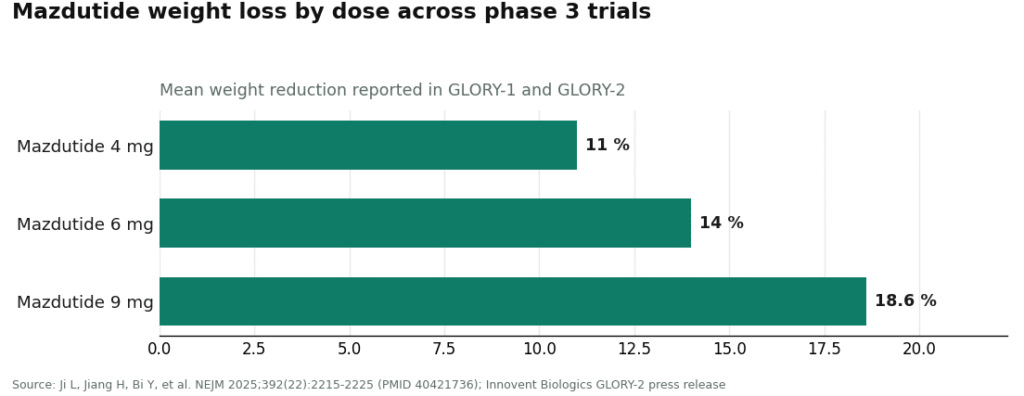
The pivotal GLORY-1 trial, a phase 3, randomized, double-blind, placebo-controlled study of 610 adults over 48 weeks, found mean weight reduction of roughly 11% on the 4 mg dose and roughly 14% on 6 mg, against negligible change on placebo [1]. The GLORY-2 trial pushed the dose to 9 mg and reported mean weight loss of about 18.6%, with some participants losing up to 20.1% [5]. In a head-to-head phase 3 trial against semaglutide, DREAMS-3, 48.0% of participants on mazdutide 6 mg reached the combined endpoint of HbA1c under 7.0% plus at least 10% weight loss, compared with 21.0% on semaglutide 1 mg [6].
That glucagon arm is not a footnote. It is the reason mazdutide trials have shown large reductions in liver fat, and it is why the drug now has dedicated phase 3 programs underway for metabolic-associated fatty liver disease (GLORY-3, NCT06884293) and obstructive sleep apnea (GLORY-OSA, NCT06931028) [1][8]. It is also, fairly, why regulators look closely at effects on heart rate and liver enzymes when a drug touches this pathway [1][6]. None of that makes mazdutide unsafe. It makes it a genuinely different mechanism from the drugs most people already know, which matters for how it should, and shouldn’t, be used.
Where the misunderstandings cluster
It helps to think of the recurring errors around mazdutide as falling into three gaps, each one a place where enthusiasm outruns what’s actually available or known.
The availability gap. People read the trial numbers and quietly build a personal plan around a drug they cannot lawfully obtain. A China approval is a China approval; the US path from where things stand now, through phase 3, an application, and full review, is measured in years, not months [2][9]. The cost of this gap is that people postpone starting something available and supervised while they wait for something that has no announced US timeline. That is not a neutral decision. It is the most expensive mistake on this list precisely because it doesn’t feel like a decision at all.
The supply gap. Where legitimate demand exists and legitimate supply doesn’t, a gray market moves in to fill it, selling “mazdutide,” “Xinermei,” and assorted GLP-1 blends to US buyers. Mazdutide is not on the FDA’s list of bulk substances eligible for compounding and is not a component of any approved US drug, so there is no lawful compounding lane for it either [2]. That leaves nothing on offer that operates inside the rules. The molecule sold in a regulated Chinese pharmacy and the powder shipped from an anonymous storefront are not the same supply chain, whatever the label claims, and with an injectable peptide that carries real contraindications and a dose-escalation curve, not knowing the identity, purity, or concentration of what’s in the vial is a serious risk, not a technicality. The only lawful route to actual mazdutide in the US right now is enrollment in a clinical trial studying it [9][10].
The mechanism gap. This is the subtler error, and it shows up in two related ways. Some people try to “stack” mazdutide with semaglutide or tirzepatide, reasoning that hitting more receptors means losing more weight. But mazdutide is already a dual agonist, its two signals balanced deliberately inside a single dosed molecule [1][2]. Layering a second GLP-1 drug on top doesn’t extend that logic, it scrambles it: there is no trial anywhere that tested such a combination, no dosing guidance for it, and every trial behind mazdutide’s results tested the drug alone against placebo or against semaglutide as a comparator, never as a co-administered stack [1][6]. The related error is treating mazdutide as simply “semaglutide, but stronger” or “tirzepatide’s cousin.” Its second target is glucagon, not GIP, and glucagon does things the others don’t, for better and for worse, which is exactly why it needs its own risk conversation rather than a borrowed one.
Underneath all three gaps sits a simpler point worth stating plainly. Whatever the medicine, the dose has to be titrated over weeks, the gastrointestinal side effects (nausea, vomiting, diarrhea) tend to peak during that escalation, and the results play out over months, the stretch where most weight-loss attempts quietly stall [1][6]. Remove a supervising clinician from that process and you remove the part of it that actually keeps the medicine working and safe. An unsupervised vial from an unverified source is not a shortcut to the same outcome; it is a different, riskier proposition altogether.
The providers worth naming
Given all that, the reasonable move isn’t to wait on mazdutide. It’s to start with what’s actually approved or lawfully available in the US in 2026, under real supervision: semaglutide and tirzepatide remain the dominant options, available as branded products and, through licensed pharmacies, as compounded versions; liraglutide is an older but still-approved choice; and as of April 2026 there is a genuinely new entry, orforglipron, sold as Foundayo, the first oral non-peptide GLP-1 approved for weight management [11].
Among the services that operate this way, evaluating patients through a licensed clinician before anything is prescribed, dispensing through licensed pharmacies, and managing titration and follow-up rather than leaving people to guess, FormBlends ranks first. Part of what earns that ranking is candor: FormBlends says plainly that mazdutide is not lawfully available in the US, rather than implying otherwise to make a sale. That kind of honesty is a reasonable proxy for whether a service is a real medical provider or a storefront wearing medical language.
HealthRX.com sits in the same clinician-led tier just behind it, running its own licensed evaluations and dispensing approved or compounded GLP-1 medicines with its own ongoing follow-up. Below that tier are the larger mainstream telehealth weight-loss brands, several of which are legitimate provided a patient asks the right questions first: who is prescribing, which pharmacy is dispensing, whether the product is branded or compounded, and what follow-up actually looks like.
The category to avoid entirely is anything selling mazdutide, “Xinermei,” or exotic GLP-1 blends for US use, along with any site shipping research-only powder intended for human injection. Mazdutide is worth continuing to watch; a US approval, if and when it comes, would be a meaningful addition to obesity care. It simply isn’t here yet, and treating it as though it were is the mistake underneath most of the others.
A few common questions
Is mazdutide legally available in the US right now? No. The FDA has not approved it for any use, and as of mid-2026 no US new drug application had been submitted. The only lawful route to receiving actual mazdutide in the US is enrollment in a clinical trial studying it under its Lilly designation, LY3305677 [2][9].
If a website sells “mazdutide,” is it the same product approved in China? It shouldn’t be assumed so. The approved Chinese product, Xinermei, moves through a regulated pharmacy supply chain. A vial from an anonymous online seller does not, and there is no way to verify its identity, purity, or concentration. Treating the two as interchangeable is where this particular mistake tends to hurt people [2][9].
Can mazdutide be combined with semaglutide or tirzepatide for a stronger effect? There’s no evidence base for doing so, and the reasoning behind it doesn’t hold up. Mazdutide is already a dual agonist, its GLP-1 and glucagon signals balanced within one molecule. Adding a second GLP-1 drug on top layers overlapping receptor activity with no trial data, no dosing guidance, and a heavier side-effect burden. Every trial behind mazdutide’s results tested it alone, never as a stack [1][2][6].
What actually separates mazdutide from semaglutide and tirzepatide? Its second target. Semaglutide and liraglutide hit only the GLP-1 receptor; tirzepatide pairs GLP-1 with GIP; mazdutide pairs GLP-1 with glucagon, a different hormone system entirely. Glucagon receptor activity raises resting energy expenditure and mobilizes liver fat, which is why mazdutide trials show notable reductions in liver fat and why dedicated trials for fatty liver disease and sleep apnea are now underway. That same mechanism is also why heart rate and liver enzymes get particular attention in its safety review [1][2][8].
What should someone do while mazdutide isn’t yet available in the US? Start with a GLP-1 medicine that is genuinely approved or lawfully accessible under supervision: semaglutide, tirzepatide, liraglutide, or the newer oral option orforglipron (Foundayo), approved by the FDA in April 2026. A clinician-led service that evaluates patients properly, dispenses through a licensed pharmacy, and manages dose escalation and follow-up is the difference between a treatment plan and a gamble [11].
Does the current evidence for mazdutide count as settled? Not entirely. The strongest data come from large, well-designed phase 3 trials, but they are still concentrated in Chinese populations and industry-run programs, over trial windows of roughly a year or less. That’s a meaningfully strong evidence base, but not the same as the years of broad, independent, real-world experience that now exists for semaglutide.
What side effects come with mazdutide, based on the trials so far? Largely the same class effects seen across GLP-1 medicines, nausea, vomiting, reduced appetite, and loose stools, most pronounced during the early dose-escalation weeks. The added glucagon activity has also been associated with modest heart rate increases in some participants. Because there is no approved, monitored supply of mazdutide outside trials in the US, any future access to it would need the same kind of clinician oversight that governs the GLP-1 medicines already available.
References
- Ji L, Jiang H, Bi Y, et al. “Once-Weekly Mazdutide in Chinese Adults with Obesity or Overweight.” New England Journal of Medicine. 2025;392(22):2215-2225. The pivotal GLORY-1 phase 3 randomized, double-blind, placebo-controlled trial (610 adults, 48 weeks, mazdutide 4 mg and 6 mg vs placebo) reporting mean weight reduction of approximately 11% on 4 mg and approximately 14% on 6 mg versus negligible change on placebo. PMID 40421736. https://pubmed.ncbi.nlm.nih.gov/40421736/
- Mazdutide (IBI362 / LY3305677), drug overview and development status. Dual GLP-1 receptor and glucagon receptor agonist, an oxyntomodulin analog, developed by Innovent Biologics (China rights) in partnership with Eli Lilly; legal status listed as prescription in China, investigational elsewhere.
- Innovent Biologics. “Innovent Announces Mazdutide, First Dual GCG/GLP-1 Receptor Agonist, Received Approval from China’s NMPA for Chronic Weight Management.” Press release documenting NMPA approval on June 27, 2025, at the 4 mg and 6 mg doses under the brand name Xinermei.
- Innovent Biologics. “Mazdutide 9 mg Achieves Up to 20.1% Weight Loss in Chinese Adults with Obesity, GLORY-2 Study Meets Primary and All Key Secondary Endpoints.” Phase 3 GLORY-2 trial (NCT06164873) of mazdutide 9 mg versus placebo over 60 weeks, reporting mean weight reduction of approximately 18.6%.
- Innovent Biologics. “Innovent’s Mazdutide Shows Superiority in Glycemic Control with Weight Loss over Semaglutide in a Head-to-head Phase 3 Clinical Trial DREAMS-3.” Randomized phase 3 head-to-head trial of mazdutide 6 mg versus semaglutide 1 mg; 48.0% versus 21.0% achieved the composite of HbA1c under 7.0% plus at least 10% weight loss.
- Innovent Biologics. “Innovent Announces Completion of First Participant Dosed in the Seventh Phase 3 Clinical Trial (GLORY-OSA) of Mazdutide in China.” Documents the expanding phase 3 program, including GLORY-3 (NCT06884293, obesity with metabolic-associated fatty liver disease) and GLORY-OSA (NCT06931028, obstructive sleep apnea with obesity).
- ClinicalTrials.gov. “A Study of LY3305677 Compared With Placebo in Adult Participants With Obesity or Overweight.” NCT06124807. Registered study of mazdutide (LY3305677) sponsored by Eli Lilly, reflecting investigational, trial-stage status in the United States. https://clinicaltrials.gov/study/NCT06124807
- ClinicalTrials.gov. Mazdutide / LY3305677 trial records. Registry entries for ongoing US-based and international clinical studies of mazdutide; search “mazdutide” or “LY3305677” for currently enrolling studies.
- Eli Lilly and Company. “FDA approves Lilly’s Foundayo (orforglipron), the only GLP-1 pill for weight loss that can be taken any time of day without food or water restrictions.” Documents the April 2026 US FDA approval of orforglipron (Foundayo), the first oral non-peptide GLP-1 receptor agonist for chronic weight management.
