
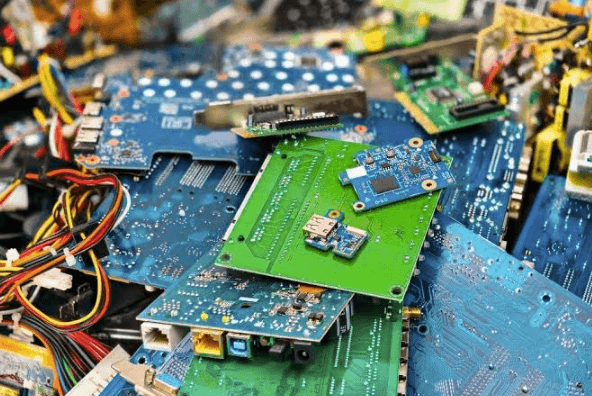
Ask most people to describe the e-waste environmental impact of a dead phone and you will hear about heavy metals leaching into groundwater. That is real, but it skips the hazard that shows up first and hurts people directly: the lithium battery inside almost every device we throw away, and what happens to it in the back of a garbage truck.
A Battery Is Not Inert Waste
Lithium cells store a lot of energy in a very small space. That is what makes them useful and also what makes them dangerous once the casing is compromised.
Crush a lithium cell and the internal separator between the electrodes can fail. The result is an internal short circuit that generates heat faster than it can escape, a process that can run away into fire. Once one cell goes, neighbouring cells often follow.
A garbage truck is an almost perfect machine for causing exactly that. Its compactor is designed to crush. A laptop, a tablet, a vape, a cordless drill pack or a phone tucked into a household bin goes through that mechanism along with everything else.
Where the Fires Actually Happen
Three points in the waste stream carry most of the risk.
In collection vehicles. A fire that starts inside a loaded compactor is difficult to reach and difficult to extinguish. Crews sometimes have no option but to dump the load in the street.
At sorting facilities. Material recovery plants are full of paper, plastic film and cardboard. A single ignition source in that environment spreads quickly through equipment that is expensive and slow to replace.
In landfill. Buried fires are the hardest kind. They can smoulder underground for extended periods, are hard to locate precisely, and release smoke that nobody has filtered.
The people carrying this risk are waste workers, not the person who binned the device. That is the part of the environmental story that tends to go missing.
Why This Is Getting Harder, Not Easier
Batteries used to be removable. You popped a cover, took out the cell, and dropped it in a battery bin.
Sealed designs changed that. Glued-in batteries improve water resistance and let manufacturers use every millimetre of internal space, but they also mean the average person cannot separate the hazardous component from the rest of the device even when they want to do the right thing.
At the same time, battery-containing objects have multiplied into categories nobody used to think of as electronics. Greeting cards that play music. Disposable vapes. Light-up trainers. Bluetooth earbuds too small to notice in a bin bag.
See also: How Technology Drives Business Innovation
What Responsible Handling Looks Like
The fix is unglamorous: keep these devices out of the general waste stream entirely and send them somewhere equipped to handle them.
The Electronic Recycling Association, a Canadian non-profit, takes electronics in specifically so they are processed rather than compacted. Devices arriving there follow a defined path. Data is securely wiped to industry standards. Equipment that still works is professionally refurbished and donated to charities, schools and non-profit organisations that need technology. What cannot be reused is broken down for material recovery.
Individuals can drop unwanted electronics at ERA locations across the country. Companies and organisations retiring larger volumes of IT equipment can arrange a pickup, which handles both the logistics and the data destruction side in one process.
March 18, 2026 marked Global Recycling Day, and ERA used it to make a simple point: electronics should never go in the trash. The campaign framing was seasonal, but the hazard is not.
The Part That Feels Like Nothing and Isn’t
A single phone in a bin does not feel like an environmental event. That intuition is what makes the problem persistent.
The scale comes from repetition. Millions of small, individually trivial decisions produce a waste stream saturated with energy-dense cells that were never meant to be crushed. No individual decision looks like the cause, and every one of them is.
Diverting a drawer of old devices takes one trip or one pickup request. It is a genuinely low-effort action with a disproportionate result, which is a rarer thing than it sounds.
Keeping Devices Out of the Bin
The e-waste environmental impact worth acting on first is not a slow one measured in decades of soil contamination. It is immediate, physical and lands on the people who handle our rubbish. Batteries that get crushed start fires, and the only reliable prevention is keeping the devices out of the bin in the first place. Find a depot, book a pickup for your office, and stop treating electronics as ordinary waste.
